

As a high skilled migrant who has made New Zealand my home, I am deeply grateful for the opportunities this country has offered me and my family. New Zealand stands out globally as a high-trust, low-corruption society—one where people generally do the right thing, even when no one is watching. This trust is a major reason why many of us choose to build our lives here. That is why recent high-profile cases of large-scale fraud by migrants feel especially painful and disappointing.
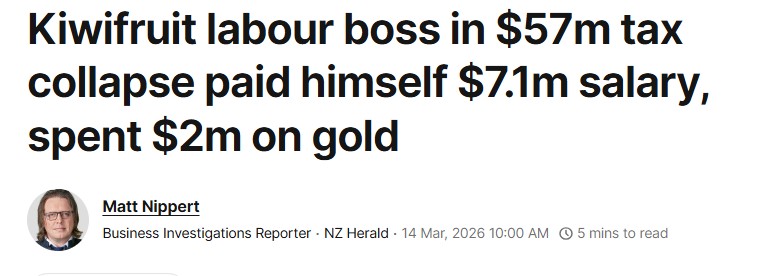
These are not small-scale taxpayer errors or minor lapses. For example, Neha Sharma, a highly qualified professional with a PhD in chemical engineering, along with her husband Amandeep Sharma, admitted to defrauding Oranga Tamariki of more than $2 million through a calculated insider scheme. In the Bay of Plenty, companies linked to kiwifruit labour contractor Ajaypal Singh were placed into liquidation, allegedly owing Inland Revenue around $57 million in unpaid taxes. Such breaches undermine public confidence in the systems we all rely on.
Serious criminal offending by some migrants goes beyond financial fraud. Cases involving large-scale drug offending or even murder by non-citizens or recent residents highlight the risks when individuals fail to uphold the values of their adopted home. These acts not only harm victims and communities but also strain public resources and trust.
I do not believe these incidents represent the majority of migrants. The vast majority of us—skilled workers, families, and contributors—work hard, pay our taxes honestly, obey the law, and actively contribute to New Zealand. Yet when high-profile cases like these occur, they cast a shadow over all migrants who play by the rules. They fuel unfair stereotypes and make it harder for law-abiding migrants to feel fully accepted. People involved in such serious offending do a disservice not just to New Zealand, but to every migrant who respects this society.
New Zealand’s strength lies in its high-trust culture: open systems, straightforward processes, and a genuine welcome for those who contribute. In return, migrants have a clear obligation to live by the same values. This means more than avoiding serious crime. It includes respecting everyday laws—driving safely without drink-driving or excessive speeding, not littering our streets or public spaces, and honouring the spirit of the rules that keep society functioning smoothly. When migrants are caught in offences and later need character references from community organisations for visa renewals, it signals a failure to fully internalise what it means to belong here.
Under current New Zealand law, non-citizen residents can face deportation for serious criminal offences, but only if the offending occurs within a limited period after gaining residence (generally up to 10 years for the most serious cases). The government has introduced the Immigration (Enhanced Risk Management) Amendment Bill, which would extend this deportation liability period to 20 years for serious crimes by residence-class visa holders. This is a positive step toward greater accountability. The ACT Party supports the extension to 20 years but argues it does not go far enough—they propose removing any time limit entirely, making deportation liability unlimited for serious offending by residents.
However, expanding the period to 20 years — or even making it indefinite — has limited practical effect for many cases. Most migrants who intend to stay long-term obtain New Zealand citizenship after living here as residents for just five years. Once citizenship is granted, the person is no longer subject to deportation under immigration rules, even for serious offending committed later. Unless the law also includes a provision that applies to first-generation citizens, these tougher measures will have only limited scope and will fail to protect New Zealand’s high-trust society in the long term.
In my view, we should go further still. For first-generation migrants who later become New Zealand citizens, there should be a meaningful probationary period — at least 10 years after naturalisation — during which serious breaches such as large-scale fraud, significant tax evasion, drug offending, or even murder could still result in deportation (with appropriate legal safeguards and review processes). Citizenship is a profound privilege and a commitment to New Zealand’s values, not an immediate or absolute shield from consequences for grave betrayals of trust. A 10-year window would allow time to demonstrate genuine integration and long-term commitment while sending a clear message: gaming the system or committing serious crimes carries lasting repercussions, irrespective of visa or citizenship status.
Deportation in such cases can also be a more practical and cost-effective option for taxpayers. Keeping someone in prison is expensive, with the Department of Corrections incurring significant daily costs per inmate (public figures and operational references have historically pointed to hundreds of dollars per day when full expenses are considered). For long sentences involving serious fraud, drugs, or violence, the total cost to New Zealand taxpayers quickly runs into hundreds of thousands or millions of dollars. Deportation after serving a minimum term, where legally possible, could reduce this burden while still delivering justice and protecting the community.
This perspective is not anti-migrant. It is about protecting the very qualities—fairness, opportunity, safety, and trust—that make New Zealand so attractive and livable for everyone. Firm, consistent consequences for those who try to game the system, combined with clearer expectations during settlement and stronger enforcement, would help preserve public confidence and the welcome we all benefit from.
As migrants, we are not temporary guests; we are stakeholders in this society. We chose New Zealand because of its values and way of life. The best way to honour that choice—and to ensure these benefits endure for future generations—is for all of us to uphold the same high standards.
If we allow serious breaches to erode trust, we risk weakening the very foundations that drew us here. Instead, let us work together—migrants and New Zealanders alike—to preserve this high-trust society, so it remains strong and welcoming for everyone who respects its values.
(The proposed Immigration (Enhanced Risk Management) Amendment Bill is open for submission. The closing date for submissions is 11.59pm on Wednesday, 29 April 2026. You can give your feedback here)